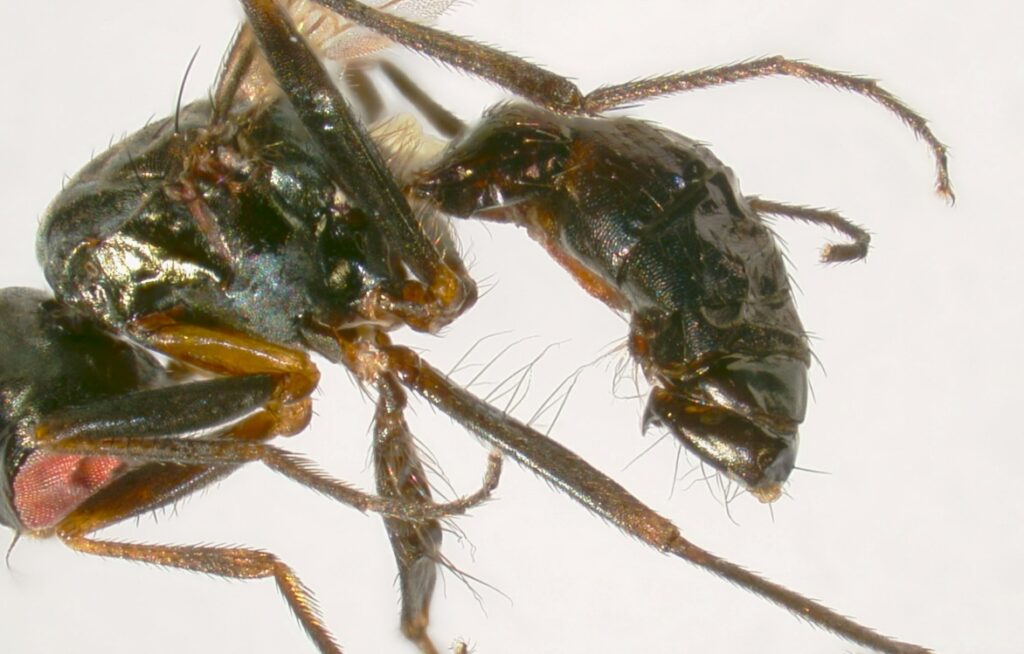

Sepsis duplicata showing the setae on mid and hind femurs – Copyright Diptera IDS 2025
Returning to working through a sample from a local cliff top, calcareous grassland, there were a surprising number of Sepsidae species included. Normally on a site, I tend to find two or three species but not seven, as I’ve just found from a single sample. Interestingly the common species (Sepsis fulgens) that is usually found everywhere, was not included in this sample. Along with Saltella spondylii, Sepsis cynipsea, S. flavimanna, S. orthocnemis, S. thoracica and Themira annulipes was a species I’ve not encountered before; Sepsis duplicata.
This is a small fly (wing ≤ 2mm) with localised distribution. Unlike other Sepsis species the male front femur lacks groups of strong ventral setae or protuberances with spinules on the tips. The mid femur has very long anteroventral and posteroventral setae on the basal half that are twice as long as the femur is deep, the hind femur has a dense curtain of thin anteroventral and posteroventral setae on the basal half. As with all of the other Sepsis species mentioned S. duplicata needs dung for the larvae to develop but in this case, being slightly more picky, this needs to be fresh cow poo!